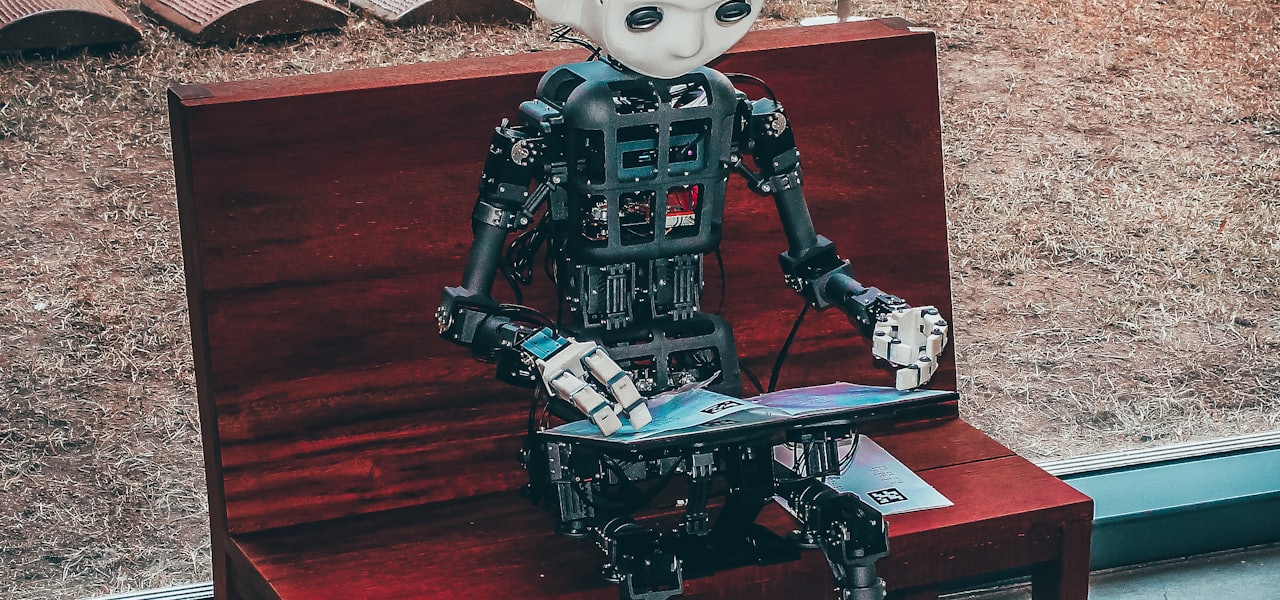
Quantum robotics is an interdisciplinary field that investigates the intersection of robotics and quantum mechanics. This field, in particular, explores the applications of quantum phenomena such as quantum entanglement within the realm of robotics. Examples of its applications include quantum communication in multi-agent cooperative robotic scenarios, the use of quantum algorithms in performing robotics tasks, and the integration of quantum devices (e.g., quantum detectors) in robotic systems. == Introduction == The free-space quantum communication between mobile platforms was proposed for reconfigurable quantum key distribution (QKD) applications using unmanned aerial vehicle (UAVs, a.k.a. drones) in 2017. This technology was later advanced in various aspects in mobile drone and vehicle platforms in several configurations such as drone-to-drone, drone-to-moving vehicle, and vehicle-to-vehicle systems. Some research has contributed to low-size, low-weight, and low-power quantum key distribution systems for small-form UAVs, the characterization of a polarization-based receiver for mobile free-space optical QKD, and optical-relayed entanglement distribution using drones as mobile nodes. The topic of free-space quantum communication between mobile platforms, initially developed to meet the need for free-space QKD and entanglement distribution using mobile nodes, was brought into the robotics domain as an emerging interdisciplinary mechatronics topic to investigate the interface between quantum technologies and the robotic systems domain. The main advantage of such integrated technology is the guaranteed security in communication between multi-agent and cooperative autonomous systems. Other advances are anticipated. == Quantum entanglement == According to quantum mechanics, entanglement occurs when more than one particle become connected. If the state of one particle changes then it will instantly change the state of other particles regardless of their distance. Entangled sensors do the same kind of work and achieve strong sensitivity. A group of quantum robots can measure magnetic fields, gravitational fields and other physical properties using entangled sensors with high rate of accuracy. Again the connection of one robot to other is increased (become strong) by quantum entanglement. == Quantum teleportation == Quantum teleportation is the transfer of quantum information (not physical objects). This is used in case of multi robot process. One robot is programmed with a complex quantum update. Then that robot can teleport that complex quantum information (the update) to other robots. This teleportation or communication is very secure because all the work is done in quantum state. == Kinematics == Quantum computing has been proposed as being optimal for calculating inverse kinematics values. == Alice and Bob robots == In the realm of quantum mechanics, the names Alice and Bob are frequently employed to illustrate various phenomena, protocols, and applications. These include their roles in QKD, quantum cryptography, entanglement, and teleportation. The terms "Alice Robot" and "Bob Robot" serve as analogous expressions that merge the concepts of Alice and Bob from quantum mechanics with mechatronic mobile platforms (such as robots, drones, and autonomous vehicles). For example, the Alice Robot functions as a transmitter platform that communicates with the Bob Robot, housing the receiving detectors.
Automated negotiation
Automated negotiation is a form of interaction in systems that are composed of multiple autonomous agents, in which the aim is to reach agreements through an iterative process of making offers. Automated negotiation can be employed for many tasks human negotiators regularly engage in, such as bargaining and joint decision making. The main topics in automated negotiation revolve around the design of protocols and negotiating strategies. == History == Through digitization, the beginning of the 21st century has seen a growing interest in the automation of negotiation and e-negotiation systems, for example in the setting of e-commerce. This interest is fueled by the promise of automated agents being able to negotiate on behalf of human negotiators, and to find better outcomes than human negotiators. == Examples == Examples of automated negotiation include: Online dispute resolution, in which disagreements between parties are settled. Sponsored search auction, where bids are placed on advertisement keywords. Content negotiation, in which user agents negotiate over HTTP about how to best represent a web resource. Negotiation support systems, in which negotiation decision-making activities are supported by an information system.
Best AI Video Editors in 2026
Shopping for the best AI video editor? An AI video editor is software that uses machine learning to help you get more done — it keeps getting smarter as the underlying models improve. Pricing, accuracy, and the size of the model behind the tool are the three factors that most affect daily usefulness. Whether you are a beginner or a pro, the right AI video editor slots into your workflow and pays for itself fast. Below we compare features, pricing, and real output so you can choose with confidence.
Ancient text corpora
Ancient text corpora are the entire collection of texts from the period of ancient history, defined in this article as the period from the beginning of writing up to 300 AD. These corpora are important for the study of literature, history, linguistics, and other fields, and are a fundamental component of the world's cultural heritage. Chinese, Latin, and Greek are examples of ancient languages with significant text corpora, although much of these corpora are known to us via transmission (frequently via medieval manuscript copies) rather than in their original form. These texts – both transmitted and original – provide valuable insights into the history and culture of different regions of the world, and have been studied for centuries by scholars and researchers. Other ancient texts – particularly stone inscriptions and papyrus scrolls – have been published following archaeological research, notably the cuneiform corpus of c.10 million words and the c.5 million words in ancient Egyptian. Through advances in technology and digitization, ancient text corpora are more accessible than ever before. Tools such as the Perseus Digital Library and the Digital Corpus of Sanskrit have made it easier for researchers to access and analyze these texts. == Quantifying the corpora == Two types of ancient texts are known to modern scholars – those that have only survived in younger manuscripts, but whose great age is undisputed (this applies to the bulk of the Chinese, Brahmi, Greek, Latin, Hebrew and Avestan tradition), and those known from original inscriptions, papyri and other manuscripts. Counting of the words in each corpus presents significant methodological challenges – in principle, every single occurrence of a word in the text is counted separately, but in the case of parallel transmission of literary texts, only a single transmission is taken into account. Just as the Book of the Dead and the coffin texts are only included once in the number given for the Egyptian, the Greek and Latin literary works should only be counted according to one manuscript. If, on the other hand, tombs, royal inscriptions or economic documents of certain ancient languages often show a more or less identical form, this is not evaluated as a purely "parallel tradition". Attached prepositions are counted as separate words, except in the case of the definite article in Hebrew, Aramaic and Greek since it has no equivalent in most languages, so its frequency would significantly affect the comparability of numbers. === Languages with known size estimates === === South Asian === Sanskrit (Vedic Sanskrit and Classical Sanskrit) Indus script (3,800 items, c.20,000 characters) Brahmi script Old Tamil Early Indian epigraphy and Indian epic poetry Kharosthi Pali literature List of historic Indian texts === Mesoamerican === Olmec hieroglyphs Maya script === East Asian === Old Chinese Chinese classics The pre-Qin corpus: a collection of ancient Chinese texts written before the Qin dynasty (221 BCE). The corpus includes texts from Confucianism, Taoism, Legalism, and other schools of thought. The pre-Han corpus: a collection of ancient Chinese texts written before the Han dynasty (202 BCE). The corpus includes texts from Confucianism, Taoism, Legalism, and other schools of thought. See the Chinese Text Project Chinese bronze inscriptions, Oracle bone script, Seal script, Clerical script === Central Iranian languages === Prior to 300 AD, the Central Iranian languages are mainly in the form of Sassanid stone inscriptions in the two closely related idioms Middle Persian (Pahlavi scripts and Inscriptional Parthian), there are 5000 for the corpus of Middle Persian (mostly 3rd, but also 4th/5th centuries) and for the corpus of Parthian (3rd century) 3000 words. To what extent some of the Manichaean Middle Persian literary texts may date back to the 3rd century is difficult to estimate; Mani is said to have personally written the Shabuhragan totaling about 5000 words. In any case, if we combine Middle Persian and Parthian, we come to over 10,000 words. === Proto-Sinaitic === Proto-Sinaitic script has no more than about 400 letters (number of words is unknown since the script has not been fully interpreted). To a similar extent, there are probably approximately contemporaneous Proto-Canaanite inscriptions (ibid.). === Anatolian === Luwian cuneiform, approx. 3000 words the Palaic language few hundred words. Hieroglyphic Luwian the Lycian alphabet (the best attested Anatolian successor language written in alphabetic script) with about 5000 words The Lydian alphabet 109 inscriptions comprising about 1500 words The Phrygian alphabet the in-tomb inscriptions from the 2nd and 3rd centuries AD (approx. 1000 words) and in the so-called "old Phrygian" inscriptions less than 300 words The Carian alphabets whose texts, mainly from Egypt, contain around 600 words. === Old Italic === the Umbrian language attested essentially by the sacrificial instructions of the Iguvinian Tables with 5000 words the Oscan language (ibid.) with 2000 words the Messapic language with probably a good 1000 words (the estimate is difficult because most texts in this hardly understandable language do not use word separators) the Venetic language a few hundred words the Faliscan language a few hundred words Cisalpine Celtic inscriptions amount to approximately 2000 words, to which are added a number of glosses by classical authors === Iberia === Iberian scripts, more rarely written in Greek or Latin script, approx. 2500 words Celtiberian script, which refers to Celtic language testimonies in Iberian, but also in Latin script from Spain (approx. 1000 words) Southwest Paleohispanic script, 78 inscriptions, a few hundred words Lusitanian language, three monuments in Latin script, approx. 60 words === Germanic Northern Europe === Runic inscriptions dated before the 4th century amount to about 30 pieces, which contain no more than 50 words in total === Africa === Geʽez script: comparatively few inscriptions with a total of around 1,000 words before 300 AD. Following Christianization in the 4th century, more extensive texts are known. Libyco-Berber alphabet: over 1,000 inscriptions from the Maghreb, which are dated to Roman times. Most texts do not use a word separator; Peust estimates that the total number of words could be around 5,000 Meroitic script (Ancient Nubian): about 900 texts are known, which Peust estimates may contain approximately 10,000 words, albeit with uncertainty from the fact that the word separator is not used consistently in the Meroitic script. === Aegean === The Cretan Linear A inscriptions that have not yet been deciphered are available in about 2500 texts, which contain a total of around 20,000 characters. The total number of words can hardly be determined; Peust tentatively put it in the same order of magnitude as in Meroitic. In addition to the Linear A texts, there are also inscriptions Cretan hieroglyphs of a few hundred characters and texts written in the Greek alphabet, but not in Greek, with a few dozen words Cypriot syllabary in the first millennium BC, in which mostly Greek texts were recorded. The relevant texts comprise around 100 to 200 words. === Micro corpora === There are a significant number of ancient micro-corpus languages. Estimating the total number of attested ancient languages may be as difficult as estimating their corpus size. For example, Greek and Latin sources hand down an enormous amount of foreign-language glosses, the seriousness of which is not always certain. == Preservation and curation == Historic preservation and maintaining ancient text corpora presents several challenges, including issues with preservation, translation, and digitization. Many ancient texts have been lost over time, and those that survive may be damaged or fragmented. Translating ancient languages and scripts requires specialized expertise, and digitizing texts can be time-consuming and resource-intensive. == Corpus linguistics == The field of corpus linguistics studies language as expressed in text corpora. This includes the analysis of word frequency, collocations, grammar, and semantics. Ancient text corpora provide a valuable resource for corpus linguistics research, enabling scholars to explore the evolution of language and culture over time.
Datacap
Datacap (an IBM Company), a privately owned company, manufactures and sells computer software, and services. Datacap's first product, Paper Keyboard, was a "forms processing" product and shipped in 1989. In August 2010, IBM announced that it had acquired Datacap for an undisclosed amount. == Overview == Datacap sells products through a value-added distribution network worldwide. The software is classified as "enterprise software", meaning that it requires trained professionals to install and configure. Although the Company has focused on providing solutions for scanning paper documents, most recently Company materials have emphasized customer requirements to handle electronic documents ("eDocs"), documents being received into an organization electronically (usually email). Datacap claims that its software is unique because of the rules engine ("Rulerunner") used for processing inbound documents, including performing the image processing (deskew, noise removal, etc.), optical character recognition (OCR), intelligent character recognition (ICR), validations, and export-release formatting of extracted data to target ERP and line of business application.
Eigenface
An eigenface ( EYE-gən-) is the name given to a set of eigenvectors when used in the computer vision problem of human face recognition. The approach of using eigenfaces for recognition was developed by Sirovich and Kirby and used by Matthew Turk and Alex Pentland in face classification. The eigenvectors are derived from the covariance matrix of the probability distribution over the high-dimensional vector space of face images. The eigenfaces themselves form a basis set of all images used to construct the covariance matrix. This produces dimension reduction by allowing the smaller set of basis images to represent the original training images. Classification can be achieved by comparing how faces are represented by the basis set. == History == The eigenface approach began with a search for a low-dimensional representation of face images. Sirovich and Kirby showed that principal component analysis could be used on a collection of face images to form a set of basis features. These basis images, known as eigenpictures, could be linearly combined to reconstruct images in the original training set. If the training set consists of M images, principal component analysis could form a basis set of N images, where N < M. The reconstruction error is reduced by increasing the number of eigenpictures; however, the number needed is always chosen less than M. For example, if you need to generate a number of N eigenfaces for a training set of M face images, you can say that each face image can be made up of "proportions" of all the K "features" or eigenfaces: Face image1 = (23% of E1) + (2% of E2) + (51% of E3) + ... + (1% En). In 1991 M. Turk and A. Pentland expanded these results and presented the eigenface method of face recognition. In addition to designing a system for automated face recognition using eigenfaces, they showed a way of calculating the eigenvectors of a covariance matrix such that computers of the time could perform eigen-decomposition on a large number of face images. Face images usually occupy a high-dimensional space and conventional principal component analysis was intractable on such data sets. Turk and Pentland's paper demonstrated ways to extract the eigenvectors based on matrices sized by the number of images rather than the number of pixels. Once established, the eigenface method was expanded to include methods of preprocessing to improve accuracy. Multiple manifold approaches were also used to build sets of eigenfaces for different subjects and different features, such as the eyes. == Generation == A set of eigenfaces can be generated by performing a mathematical process called principal component analysis (PCA) on a large set of images depicting different human faces. Informally, eigenfaces can be considered a set of "standardized face ingredients", derived from statistical analysis of many pictures of faces. Any human face can be considered to be a combination of these standard faces. For example, one's face might be composed of the average face plus 10% from eigenface 1, 55% from eigenface 2, and even −3% from eigenface 3. Remarkably, it does not take many eigenfaces combined together to achieve a fair approximation of most faces. Also, because a person's face is not recorded by a digital photograph, but instead as just a list of values (one value for each eigenface in the database used), much less space is taken for each person's face. The eigenfaces that are created will appear as light and dark areas that are arranged in a specific pattern. This pattern is how different features of a face are singled out to be evaluated and scored. There will be a pattern to evaluate symmetry, whether there is any style of facial hair, where the hairline is, or an evaluation of the size of the nose or mouth. Other eigenfaces have patterns that are less simple to identify, and the image of the eigenface may look very little like a face. The technique used in creating eigenfaces and using them for recognition is also used outside of face recognition: handwriting recognition, lip reading, voice recognition, sign language/hand gestures interpretation and medical imaging analysis. Therefore, some do not use the term eigenface, but prefer to use 'eigenimage'. === Practical implementation === To create a set of eigenfaces, one must: Prepare a training set of face images. The pictures constituting the training set should have been taken under the same lighting conditions, and must be normalized to have the eyes and mouths aligned across all images. They must also be all resampled to a common pixel resolution (r × c). Each image is treated as one vector, simply by concatenating the rows of pixels in the original image, resulting in a single column with r × c elements. For this implementation, it is assumed that all images of the training set are stored in a single matrix T, where each column of the matrix is an image. Subtract the mean. The average image a has to be calculated and then subtracted from each original image in T. Calculate the eigenvectors and eigenvalues of the covariance matrix S. Each eigenvector has the same dimensionality (number of components) as the original images, and thus can itself be seen as an image. The eigenvectors of this covariance matrix are therefore called eigenfaces. They are the directions in which the images differ from the mean image. Usually this will be a computationally expensive step (if at all possible), but the practical applicability of eigenfaces stems from the possibility to compute the eigenvectors of S efficiently, without ever computing S explicitly, as detailed below. Choose the principal components. Sort the eigenvalues in descending order and arrange eigenvectors accordingly. The number of principal components k is determined arbitrarily by setting a threshold ε on the total variance. Total variance v = ( λ 1 + λ 2 + . . . + λ n ) {\displaystyle v=(\lambda _{1}+\lambda _{2}+...+\lambda _{n})} , n = number of components, and λ {\displaystyle \lambda } represents component eigenvalue. k is the smallest number that satisfies ( λ 1 + λ 2 + . . . + λ k ) v > ϵ {\displaystyle {\frac {(\lambda _{1}+\lambda _{2}+...+\lambda _{k})}{v}}>\epsilon } These eigenfaces can now be used to represent both existing and new faces: we can project a new (mean-subtracted) image on the eigenfaces and thereby record how that new face differs from the mean face. The eigenvalues associated with each eigenface represent how much the images in the training set vary from the mean image in that direction. Information is lost by projecting the image on a subset of the eigenvectors, but losses are minimized by keeping those eigenfaces with the largest eigenvalues. For instance, working with a 100 × 100 image will produce 10,000 eigenvectors. In practical applications, most faces can typically be identified using a projection on between 100 and 150 eigenfaces, so that most of the 10,000 eigenvectors can be discarded. === Matlab example code === Here is an example of calculating eigenfaces with Extended Yale Face Database B. To evade computational and storage bottleneck, the face images are sampled down by a factor 4×4=16. Note that although the covariance matrix S generates many eigenfaces, only a fraction of those are needed to represent the majority of the faces. For example, to represent 95% of the total variation of all face images, only the first 43 eigenfaces are needed. To calculate this result, implement the following code: === Computing the eigenvectors === Performing PCA directly on the covariance matrix of the images is often computationally infeasible. If small images are used, say 100 × 100 pixels, each image is a point in a 10,000-dimensional space and the covariance matrix S is a matrix of 10,000 × 10,000 = 108 elements. However the rank of the covariance matrix is limited by the number of training examples: if there are N training examples, there will be at most N − 1 eigenvectors with non-zero eigenvalues. If the number of training examples is smaller than the dimensionality of the images, the principal components can be computed more easily as follows. Let T be the matrix of preprocessed training examples, where each column contains one mean-subtracted image. The covariance matrix can then be computed as S = TTT and the eigenvector decomposition of S is given by S v i = T T T v i = λ i v i {\displaystyle \mathbf {Sv} _{i}=\mathbf {T} \mathbf {T} ^{T}\mathbf {v} _{i}=\lambda _{i}\mathbf {v} _{i}} However TTT is a large matrix, and if instead we take the eigenvalue decomposition of T T T u i = λ i u i {\displaystyle \mathbf {T} ^{T}\mathbf {T} \mathbf {u} _{i}=\lambda _{i}\mathbf {u} _{i}} then we notice that by pre-multiplying both sides of the equation with T, we obtain T T T T u i = λ i T u i {\displaystyle \mathbf {T} \mathbf {T} ^{T}\mathbf {T} \mathbf {u} _{i}=\lambda _{i}\mathbf {T} \mathbf {u} _{i}} Meaning that, if ui is an eigenvector of TTT, then vi = Tui is an eigenvector of S. If we have
Talkman
Talkman is an edutainment video game developed and published by Sony Computer Entertainment for the PlayStation Portable. It utilizes voice-activated translation software that operates in four languages, Japanese, English, Korean, and Mandarin Chinese. The name "Talkman" is a reference to Sony's Walkman line of portable audio products. It was released in Japan on November 17, 2005, and in America on August 5, 2008 (via the PlayStation Store), as Talkman Travel. In America, however, instead of receiving all the languages included in the Japanese version in one package, single-language packs are available for $2.99 each. Available packs are: Paris (French), Rome (Italian), and Tokyo (Japanese). The software is designed for travelers and entertainment, mostly containing slang and useful travel phrases. While originally sold in and designed for the Japanese market for Japanese users, its translation function operates between all four languages. In Japan, the software has proven popular with the middle-aged female demographic due to an interest in South Korean products, and Korean-language soap operas and movies; and as a fun English education aid for children. Outside of pure translations, Talkman also lets players play games to test their fluency of a language. The program comes with a USB microphone included. This microphone draws power through two gold-colored contacts on the top of the PSP, one on each side of the mini-USB port. This is uncommon due to the ability for most USB products to draw power through USB. These proprietary contacts are similar to the gold-colored contacts on the bottom-right of the device, which are used for charging. Note: The Chotto Shot (aka "Go!Cam") has a built-in microphone that also can be used with the Talkman program. Furthermore, the PSP-3000 model and PSP Go have built-in microphones that work with this application, without the need for any external attachments. == Talkman Euro == Following the success of the Asian version of Talkman, a version designed for translating European languages was developed and released on June 16, 2006. Talkman Euro is available in two versions. The Japanese version contains support for English, Italian, Spanish, German, French, and Japanese, while the Chinese version contains support for Traditional Chinese instead of Japanese. The differences on the packaging (the Japanese flag as opposed to a flag with the word "mie" in Chinese) are minimal and hard to notice. == Talkman UMD-only package == Talkman is also released as a UMD-only package, so users who already have the USB mic or camera can choose to purchase this standalone version. The Sony PSP Headset and the built-in microphone on later model PSPs have also been confirmed to work with Talkman.